1. シャツに えが かいてあります。
2. このかん字は「あめ」と読みます。
3. このマークは「あぶない」という意味です。
4. その紙に 何が かいてありますか。
5. このマークは どういう意味ですか。
1. ~中 📢:in, on ex.) かいぎ中=in a meeting, りょこう中=on a trip
2. マーク 📢:mark
3. かなしい 📢:sad
4. えも字 📢:emoji
5. うれしい 📢:glad
6. ちず 📢:map
7. どういう 📢:how
8. さわります1 📢:touch
In this lesson, we will study how to describe the photo/picture and written letter/character. It’s a little bit complex🥲 But after you master these expressions, you can describe many things in detail. Let’s try !!!
1. 【 】が/と かいてあります。
1.1 【 】が かいてあります。
To describe the design of this shirt, you say
 🚩シャツに えが かいてあります。📢
A picture is on the shirt.
Please pay attention that が is used.
To add some explanation about the picture, you say
シャツに 花の えが かいてあります。📢
A picture of a flower is on the shirt.
In case you mention the letters/characters, you use Kanji 書.
 シャツに かん字が 書いてあります。📢
Some Kanji are on the shirt.
Please remember that you can’t mention the meaning of the word or Kanji, or the details of the picture with this sentence pattern.
1.2 「 」と書いてあります。
With this sentence pattern, you can mention what the letters/characters say.
「日本」と書いてあります。📢
It says “Japan”.
Please pay attention that と is used in this sentence pattern.
「 」 are used to indicate what is said and written. These are like “ ”, ‘ ’ in English.
You can also use this sentence pattern to explain the meaning of foreign languages.

🚩「日本」と書いてあります。
To add the position of the letters/characters, you say
シャツに「日本」と書いてあります。📢
“Japan” is written on the shirt.
Use the particle に to indicate the position.
Please pay attention to the difference between と書いてあります and が書いてあります.
Let’s see the examples below.
| 🚩シャツに字が書いてあります。 | シャツに「字」と書いてあります。 |
 |
 |
| 名前が書いてあります。 | 「John」と書いてあります。 |
 |
|
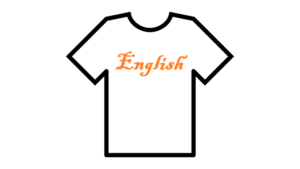
| 🚩えい語が 書いてあります。 | 「English」と書いてあります。 |
 |
|
» Let’s describe your belongings.
1 私のシャツに( )がかいてあります。
2 本に( )と書いてあります。
2. 【 】は「 」と読みます。
Next, we will explain how to read Kanji.
 🚩このかん字は🚩「あめ」🚩と読みます。📢
You read this Kanji “Ame”.
Please pay attention to は and と. Normally, 「 」are used.
» Let’s explain how to read these Kanji below.
このかん字は「 」と読みます。
1 外 2 右 3 私
1. See below and choose the proper description from A/B.
|
1. おの(A と書いてあります B が書いてあります)。 おの |
|
2. 「せつめい」(A が書いてあります B と読みます)。 説明 |
|
3. 「2月2日」(A と書いてあります B が書いてあります)。 February 2 |
|
4. 「なまえ」(A と読みます B が書いてあります)。 名前 |
|
5. (A 「3時から」 B かいぎの時間)が書いてあります。 Meeting schedule: 15:00-16:00 |
|
6. 「じかん」(A が書いてあります B と読みます)。 時間 |
|
7. (A 「こしょうちゅう」 B えい語)と書いてあります。 OUT OF ORDER |
|
8. (A 日本料理の名前 B 「すし」)と読みます。 寿司
|
3. 〈 〉は【 】という意味です。
To explain the meaning of the word, Kanji, mark, etc., you use this sentence pattern.

🚩このマークは「あぶない」🚩という意味です。📢
This mark means “dangerous”.
Please pay attention to the phrase という. という has several usages. In this sentence pattern, という is attached after the meaning to indicate the meaning.
Using 「 」 makes the meaning clear.
You can also use this sentence pattern to explain the meaning of foreign words.
🚩「sad」は「かなしい」という意味です。📢
foreign word meaning
Let’s see some other usages of という意味です.

🚩このえも字は「うれしい」という意味です。 📢

このことばは「きれいだ」という意味です。 📢
» Let’s explain the meaning of these EMOJI.
このえも字は( )という意味です。
1 🥶 2 😋 3 🤔
4. 何が/と
Now, we will study how to use these sentence patterns above in conversation.
4.1 何が 書いて/かいてありますか。
Please see the image and read the conversation.
🚩Please pay attention that 何 is read なに.

Q:そのかみに 🚩何が 書いてありますか。📢
What’s on the paper ?
A:🚩かいぎの時間が 書いてあります。📢
The meeting hour is it.
Please pay attention that が is used.
Let’s see this example.
Q:そのかみに 何が 書いてありますか。📢
A:かん字が 書いてあります。📢 Kanji are on it.
何が書いてありますか is used to ask the outline of the written content. So, even if you don’t know how to read it or the meaning, you may be able to answer.
You can also use this question for drawn materials.
Q:そのかみに 何が かいてありますか。📢
A:ちずが かいてあります。📢 A map is on the paper.
4.2 何と 書いてありますか。
This question is used to ask about the content. In this case, と is used instead of が.
Normally,「 」is used to answer. Be careful that 何 in this sentence pattern is read なん. Please pay attention to に.
🚩Q:Johnさんのメールに 🚩何と書いてありますか。📢
What does John’s email say?
🚩A:「来月アメリカに帰ります」と書いてあります。📢
He says “I will go back to the U.S. next month”.
4.3 何と読みますか。
In case you ask how to read Kanji, you say
🚩Q:あのかん字は 🚩何と読みますか。📢
How do we read that Kanji ?
A:「あめ」と読みます。📢
You read it “ame”.
5. どういう意味ですか。
To ask the meaning of word, mark, etc., どういう is used.
🚩Q:このマークは どういう意味ですか。📢
How does this mark mean?
A:「あぶない」という意味です。📢
This means ”dangerous”.
» Choose from 何が/何と/どういう to fill in the blank.
1 Q:( )書いてありますか。
A:「かいぎは3時に始まります」と書いてあります。
2 Q:( )意味ですか。
A:「コピーしないでください」という意味です。
3 Q:( )読みますか。
A:「いばらき」と読みます。
4 Q:( )書いてありますか。
A:バイクのねだんが 書いてあります。
1. See the image and choose A/B.
|
1.
このマークは(A 「さわってください」 B 「さわらないでください」)という意味です。 |
|
2.
このえは(A 「切ってください」 B 「切らないでください」)という意味です。 |
|
3.
このマークは(A 「正しい」 B 「あぶな い」)という意味です。
|
2. See the image and choose a question from A/B.
|
1.
Q:(A どういう意味ですか B 何が書いてありますか)。 A:「50%安くなる」……。 |
|
2.
Q:(A 何と読みますか B 何が書いてあり ますか)。 A:ねだん……。 |
|
3. Q:(A 何と読みますか B どういう意味ですか)。 A:「だいがく」……。 大学 |
|
4.
Q:(A どういう意味ですか B 何と読みます か)。 A:「コピ―しないでください」……。 |
|
5. Q:(A 何と書いてありますか B 何が書いてありますか)。 A:「パーティーは18時からです」……。 |
|
6.
Q:(A 何がかいてありますか B 何とかいて ありますか)。 A:「はな」……。 |
|
7. Q:(A 何と書いてありますか B 何と読みますか)。 A:「あぶない」…。 DANGEROUS |
|
8. Q:(A 何が書いてありますか B 何と読みますか)。 A:「はつか」……。 20日
|
|
1. この機械(A を B に)さわらないでください。 |
|
2. ノート(A に B で)え(C が D を)かいてあります。 |
|
3. このかん字(A に B は)「き」(C と D を)読みます。 |
|
4. このえも字(A は B を)「かなしい」(C が D と)いう 意味です。 |
|
5. Q:何(A と B を)書いてありますか。 A:「ニューヨーク」(C が D と)書いてあります。
NEW YORK |
|
6. Q:何(A と B が)読みますか。 A:「あした」(C と D を)読みます。
明日 |
|
7. Q:何(A と B が)書いてありますか。 A:アプリの使い方(C と D が)書いてあります。
|
|
1. テストの時間(A が書いてあります B と書いてあります)。
日本語のテストは 3月10日ごぜん9時からです。 |
|
2. このえも字は「言わないでください」(A と書いてあります B という意味です)。 🤫 |
|
3. 「じかん」(A といういみです B と読みます)。
時間 |
|
4. 「いそいでください」(A と読みます B という意味です)。 Hurry up ! |
|
5. 「かいぎちゅう」(A と書いてあります B が書いてあります)。 Meeting in progress |
|
6. えも字(A という意味です B がかいてあります)。 😍 😙 😶 |
|
7. (A 「むりょう」 B 「かん字」)と読みます。 無料 |
|
8.
(A 「クリックしてください」 B ボタン)という意味です。 |
|
9. (A えい語 B 「Vacation」)が書いてあります。
Vacation
|
|
1. Q:お知らせに(A なに B なん)が書いてありますか。 A:(C かいぎの 時間 D 「かいぎは10時からです」)が 書いて あります。 |
|
2. Q:あのかん字は(A どういう B なんと)読みますか。 A:(C 「えい語でexplanation」 D 「せつめい」)と読みます。 |
|
3. Q:おのさんのチャットに(A なに B なん)と書いてありますか。 A:(C 新しい 社員の 名前 D 「あした 会社に 行きます」)と 書いてあります。 |
|
4. Q:このマークは(A なんと B どういう)意味ですか。 A:(C「Do not copy」 D「コピーしないでください」)という意味 です。 |
Read and choose A/B. *This section has no highlight
Surinさんはバスの会社の人と話します。S=Surin, B=An employee of a bus company
S:すみません、きのう、バスの中で ノートとぼうしを なくしました。
B:ノートに何(1)書いてありますか。
S:はい。
B:何(2)書いてありますか。
S:私の名前が 書いてあります。「スリン」(3)書いてあります。
B:はい。
ぼうしについて聞きます。どんなぼうしですか。
S:白いぼうしで、花の絵(4)かいてあります。
B:名前(5)書いてありますか。
S:いいえ。
B:この紙に書いてください。ここに名前を書いて、ここに「ノート」「ぼうし」(6)書いてく
ださい。
S:すみません、このかん字(7)何(8)読みますか。
B:「ふんしつ」と読みます。
S:どういう意味ですか。
B:「なくした」(9)いう意味です。
S:はい。
📌Let’s study some Kanji
1 白い:しろい
2 絵:え
3 紙:かみ
|
1. A が B か |
|
2. A が B か |
|
3. A が B と |
|
4. A が B を |
|
5. A が B と |
|
6. A を B と |
|
7. A は B が |
|
8. A が B と |
|
9. A と B を |

X
X
Back to Review